
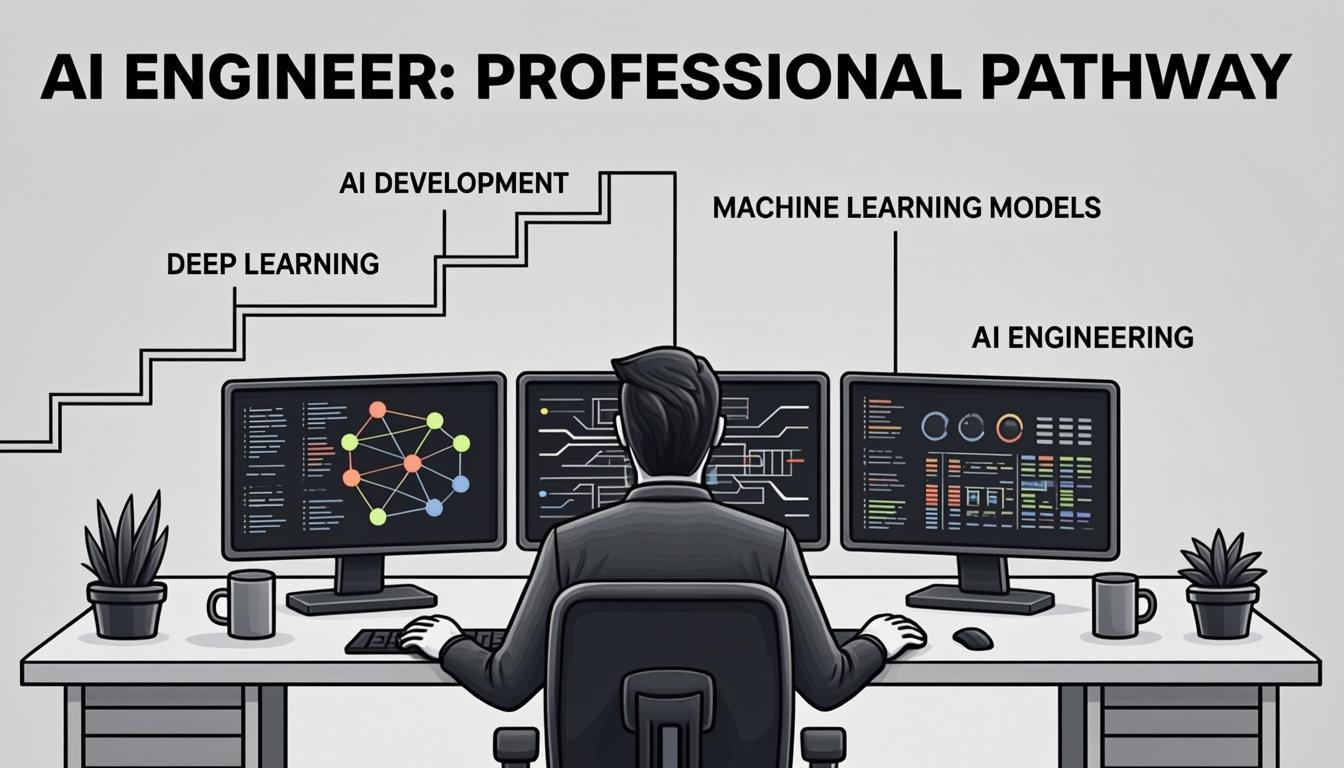
AI Engineer Career Path: Skills, Technologies and Industry Opportunities
An AI engineer designs, builds, and deploys software that uses machine learning and generative AI models. The AI engineer career path usually begins in software development, data engineering, or machine learning, then branches into specializations such as LLM applications, machine learning engineering, and AI platform engineering.
For a long time, software engineers wrote clear rules: if this input arrives, produce that output. Today, many applications work differently. They learn patterns from data, write text, find information, and take actions on a user’s behalf. Code still matters, but it is no longer the whole product.
This shift has created a new specialization. The work is less about inventing new algorithms and more about making AI useful, testable, and safe inside real products.
From Writing Code to Building Intelligent Systems
Software roles are evolving along a spectrum. Each step adds new responsibilities and does not replace the one before:
Traditional Application Development
ML-Powered Applications
Generative AI Integration
AI-Powered Automation
Agent-Based Systems
The engineering approach changes too. In traditional software, code defines the behavior and failures trace back to specific code changes. In AI engineering, data, prompts, models, and retrieval context shape the behavior, outputs can vary, and failures include hallucination, drift, bias, delay, and cost. These need monitoring after release, not just before.
Inside an AI Engineer’s Workbench: What Are They Actually Building?
Job descriptions can feel abstract. These seven kinds of systems show what the work looks like in practice.
The Technical Foundation Behind Modern AI Engineering
Think of AI engineering as five connected layers. A weak lower layer usually shows up as problems in the layers above it.
Programming and Data Foundations
Python for modeling and glue code, SQL for shaping data, data structures and algorithms, and data cleaning and validation.
Machine Learning and Model Development
Classical machine learning algorithms, neural networks and deep learning, and training and evaluation with metrics that match the business goal.
Generative AI and Language Models
LLMs, prompt engineering, RAG, fine-tuning, and agentic workflows.
AI Application Engineering
API development, vector databases, orchestration frameworks, and integration with enterprise systems, identity, and data stores.
Deployment and Production Engineering
Cloud platforms, MLOps, model monitoring for speed, cost, quality, and drift, and security including defenses against prompt injection.
A worked example: contract-review assistant
Contracts are cleaned and stored (layer 1), a classifier labels clause types (2), an LLM summarizes risk grounded in retrieved clauses (3), an API and vector index connect it to the document system (4), and the service is containerized, monitored, and secured (5). Remove any one layer, and the system either fails or cannot be trusted.
One AI Engineer Career Path, Multiple Specializations
There is no single ladder. The AI engineer career path branches into several specializations, and many professionals move between them over time.
| Specialization | Focus | Key Skills |
|---|---|---|
| Machine Learning Engineering | Training, validating, and productionizing predictive models | scikit-learn, PyTorch or TensorFlow, feature engineering, MLOps |
| Generative AI Engineering | Products built around generative models for text, images, or code | LLMs, prompt design, fine-tuning, evaluation |
| LLM Application Engineering | Reliable applications on top of existing language models | API design, vector search, orchestration, guardrails, cost and speed control |
| Natural Language Processing | Understanding and generating human language | Transformers, tokenization, linguistic evaluation |
| Computer Vision | Interpreting images and video | Convolutional and vision transformer models, data augmentation, edge deployment |
| AI Platform Engineering | Platform engineering that gives other teams shared infrastructure to build and run AI | Kubernetes, cloud architecture, observability, security |
| Applied AI Engineering | Solving a specific business problem from start to finish | Problem framing, stakeholder communication, rapid prototyping, measuring impact |
Climbing the Ladder: How Does an AI Engineer Career Progress?
Titles vary between employers, but most careers move through five broad stages. Each stage widens the scope of what you own.
Junior or Associate AI Engineer
Works on well-defined tasks inside an existing system, such as adding an evaluation set or fixing a data pipeline.
AI Engineer (Mid-Level)
Owns a feature or service from design to release and monitors quality after launch.
Senior AI Engineer
Owns a whole system, sets evaluation and reliability standards, balances quality against cost and delay, and mentors others.
Staff, Principal, or AI Architect
Sets technical direction across teams and shapes build-versus-buy, governance, security, and platform choices.
Engineering Manager or Head of AI
Leads teams and ties AI work to business outcomes, budgets, and risk.
From the senior level, careers split into an individual contributor track and a management track, and many people switch between the two. The move up is rarely about knowing more tools. It is about handling more ambiguity, more risk, and more people.
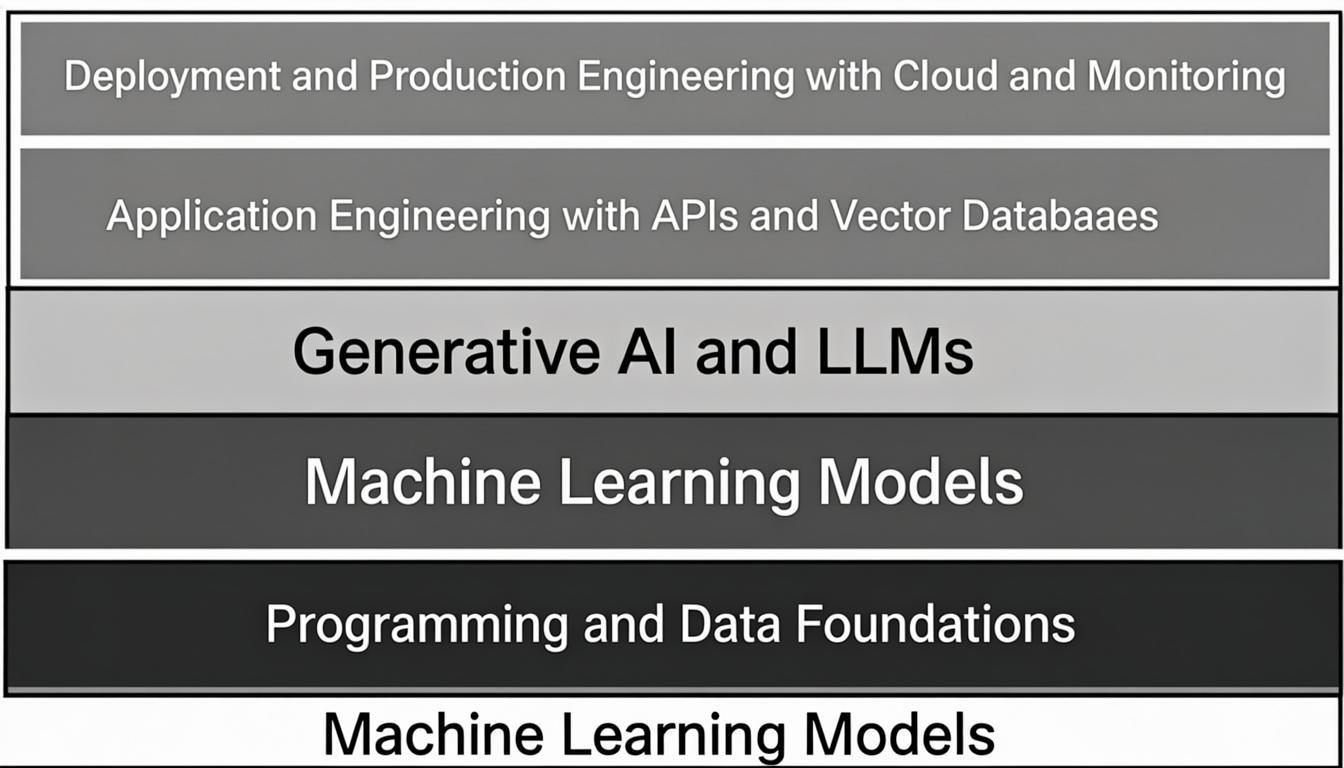 Five connected layers form the technical foundation — remove any one, and the
system either fails or cannot be trusted.
Qualifications and Roadmap: What Does It Take to Become an AI Engineer?
There is no single required qualification. Many employers prefer a degree in computer science or a related field, and research-heavy roles often expect postgraduate study, but many application-focused roles accept strong experience instead. Certifications support a portfolio and do not replace one. Deployed, documented projects with evaluation results are the strongest proof of ability.
Foundations
Python, SQL, version control, data structures, and basic software design.
Machine Learning Basics
Training, overfitting, evaluation metrics, and a first end-to-end model.
LLM Application Skills
API use, prompt design, embeddings, vector search, and a small RAG project.
Production Skills
Testing, evaluation, containers, cloud deployment, monitoring, and cost control.
Specialization & Proof
Choose one specialization, ship a documented project, and share what you learned.
Key Takeaways for Future AI Engineers
Frequently Asked Questions
The main job of an AI engineer is to build, test, and run AI-powered features inside real products. A typical day includes writing application code and APIs, refining prompts or retrieval, reviewing evaluation results, fixing data problems, and checking monitoring dashboards for quality, cost, and delay.
AI engineers can specialize in machine learning engineering, generative AI engineering, LLM application engineering, natural language processing, computer vision, AI platform engineering, or applied AI engineering. Over time they can grow through senior and staff levels as individual contributors, or move into AI architecture and engineering management.
Python and SQL come first, followed by machine learning basics, API design, and LLM skills such as prompt engineering, embeddings, vector search, and retrieval-augmented generation. Production skills matter just as much: evaluation, deployment, monitoring, security, and control of cost and response time. Communication helps at every level.
There is no single best path. It depends on your background and goals. Software developers often suit LLM application engineering, data engineers often move toward ML pipelines and platform work, and people who enjoy statistics and research suit machine learning or NLP. Choose the path that builds on your strengths, then deepen it with deployed projects.
Start with strong Python, SQL, and software engineering skills, then learn machine learning basics and LLM application development through APIs and retrieval. Build and deploy one small AI application with evaluation and monitoring, and document it. Many application-focused roles value working projects over a specific degree.
An AI engineer builds AI features into products, an ML engineer trains and runs models at scale, and a data scientist analyzes data to support decisions. The roles overlap, and smaller organizations often combine them, so always read the job description and not just the title.
Ready to Explore the Future of AI Engineering?
AI engineering is creating new opportunities across software development, machine learning, data engineering, and enterprise technology. As organizations adopt AI-driven solutions, they need professionals who can build, integrate, and run these systems responsibly.
Whether you’re looking to advance your AI engineering capabilities or understand how these technologies are transforming business operations, connect with our technology experts to explore emerging opportunities and practical AI and machine learning services.
Connect with Our AI Experts