
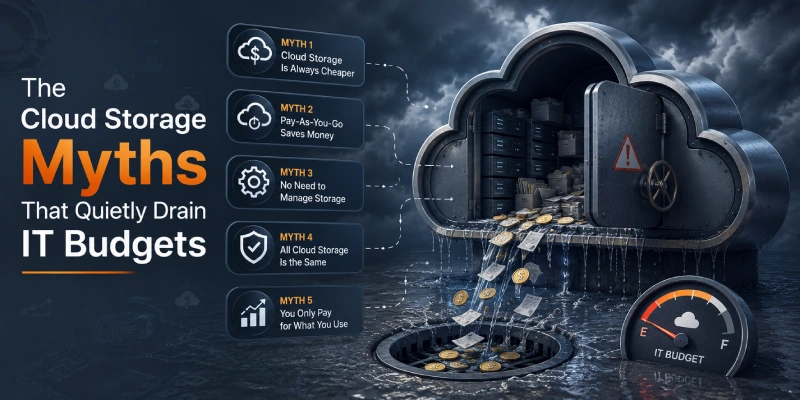
The Cloud Storage Myths That Quietly Drain IT Budgets
Ever stare at a cloud invoice and wonder how storage costs crept up again, even though nothing "big" happened this month? You're not imagining it, and you're definitely not alone. Most cloud storage overspend doesn't come from one dramatic mistake. It comes from a handful of everyday assumptions that sound perfectly reasonable, until you actually check them. The good news: once you know what to look for, these myths are surprisingly easy to fix.
Why These Myths Stick Around
Understanding the root cause helps you see why costs quietly compound.
Cloud platforms are built for speed. Spinning up a new bucket or backup policy takes seconds, which is fantastic for getting things done and not so fantastic for anyone trying to keep the bill under control six months later. On top of that, most teams simply can't see where their storage spend is going in real time. When visibility is low, myths fill the gap, and left alone, they quietly multiply across every project, every team, and every region.
Five Myths, One Big Bill
Tap each myth to reveal the reality behind it.

Hidden cost pathways in cloud storage architectures often go unnoticed until quarterly budget reviews
A Simple Framework to Stop the Leak
None of this requires a total overhaul. It just needs a repeatable process instead of a one-off cleanup — here's a simple five-step starting point.
Get a Real Baseline
Tag every storage resource by owner, environment, and purpose. Then pull a monthly spend-by-tag report before changing anything. You can't fix what you can't see.
Sort Data by How It's Actually Used
Skip the guesswork. Use access logs to figure out what belongs in hot, warm, cold, or archive storage.
Automate the Boring Part
Set lifecycle rules that move or expire data automatically based on that classification, and revisit them every quarter as usage shifts.
Re-Check Redundancy
Match replication and durability settings to what the business actually needs today, not what was configured on day one.
Model Data Movement Before You Build
Before adding a new pipeline, region, or backup strategy, estimate egress and API costs alongside storage costs, not after the fact.
A lot of this ties into bigger infrastructure decisions, from where workloads live to how data moves between them. That's exactly where a structured cloud migration and infrastructure review earns its keep, especially for teams that want a fresh, outside look at where the budget is really going.
In a Nutshell
These myths stick around because they're convenient, not because they're accurate.
| # | Key Takeaway | Related Myth | |
|---|---|---|---|
| 1 | Total cost of ownership beats price-per-gigabyte, every time. | "Cloud Is Always Cheaper" | |
| 2 | Tiers only save money when lifecycle automation is actually switched on. | "More Tiers, More Savings" | |
| 3 | A deleted file can leave behind several billed copies you never see. | "Delete Removes From Bill" | |
| 4 | Redundancy should match today's needs, not day-one defaults. | "Redundancy Doesn't Need a Second Look" | |
| 5 | Fees, not just capacity, are now a major slice of the bill. | "Egress Fees Are Negligible" |
Frequently Asked Questions
Fees. Egress charges, API requests, and cross-region replication are consistently underestimated, and industry data now points to fees making up close to half of total storage spend.
Most industry reports land somewhere between 27 and 35 percent of total cloud spend, with storage waste usually concentrated in orphaned volumes, forgotten backups, and tiers that were never optimized.
Yes, but only when they're switched on and kept up to date. Automatically moving cold data to cheaper tiers is one of the safest, most reliable ways to cut storage costs without touching performance.
Not automatically, but it does open the door to duplicated data, inconsistent tagging, and egress fees between providers. Strong governance is what keeps multi-cloud from multiplying the same waste.
A quarterly check-in works well for most teams, with a closer look after any major migration, architecture change, or new data pipeline.
Final Thought
Cloud storage bills rarely spike because of one big mistake. They
creep up because a few ordinary assumptions go unchecked for too long. The fix isn't complicated: build in a
regular review, question the defaults, and let the data tell you what's actually being used. That's the
difference between chasing your cloud bill every quarter and staying ahead of it.