
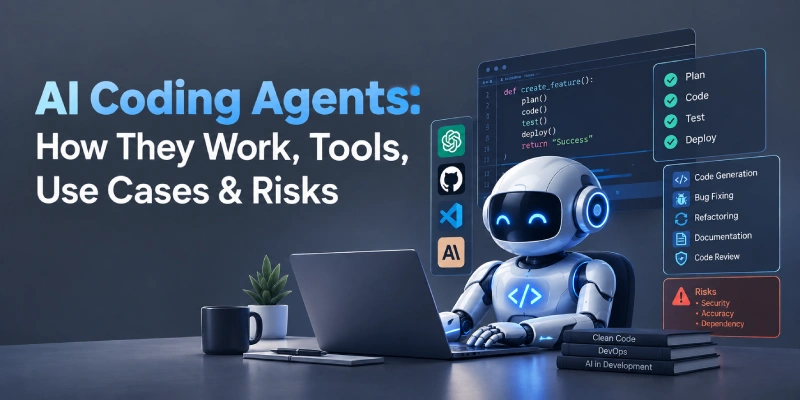
AI Coding Agents: How They Work, Tools, Use Cases & Risks
A practical, team-friendly guide to working with autonomous coding tools — from first pilot to safe rollout.
AI coding agents can plan, edit, run, and check code with limited human input. They work best on clear, bounded tasks. Give them only the access they need, and check every result before it ships.
What are AI coding agents?
AI coding agents are software systems that combine a language model with development tools to carry out coding tasks. Within the permissions you set, they can read a repository, edit files, run commands, and check the results.
Developers stay responsible for requirements, review, and release decisions. Agents are most useful when a task is clearly defined, because they cut repetitive work such as reproducing a bug, updating tests, and checking compatibility.

How agents differ from coding assistants
The difference is how much the tool does on its own.
Autocomplete
Autocomplete suggests the next piece of code. You accept or edit it.
Chat assistants
Chat assistants explain code and propose changes. You apply them and run the checks.
Coding agents
Coding agents change several files, run commands, and report results. You set the limits and inspect the work.
The more a tool does on its own, the more important clear requirements and careful review become.
How AI coding agents work
An agent uses a model to decide what to do and software tools to do it. The surrounding system supplies context, enforces permissions, and returns results.
The five-step cycle
Gather context
The agent finds the relevant files, tests, and project instructions.
Propose an approach
It identifies likely changes. For unclear work, ask for a plan before allowing edits.
Make bounded changes
It edits code, updates tests, and runs approved commands.
Inspect feedback
It reads build errors and test failures, then revises its work.
Hand over evidence
A good result includes the diff, the checks that ran, any failures, and assumptions you still need to confirm.
A simple example
Say an API returns an internal error when a page size is invalid. A focused instruction might be:
The agent traces the request, updates the validation, and tests valid and invalid inputs. You should still check upper limits, non-numeric inputs, and the API contract. A task with clear limits and expected results works far better than “Improve the API.”
Where AI coding agents help
They work best on small, well-defined tasks.
Bug fixes
Start with a bug you can reproduce. Ask the agent to add a failing test first, then fix the code.
Refactoring
Use them for repetitive updates, and split large migrations into small, reviewable changes.
Scaffolding and documentation
They can draft a small endpoint, a UI component, or docs tied to code. Review the result as carefully as hand-written code.
AI coding agent tools to try
For a broader comparison of tools and a team-wide rollout framework, see our guide to autonomous development.
| Tool | What it does |
|---|---|
| GitHub Copilot cloud agent | Works in the background on a branch and runs tests in GitHub Actions. |
| Claude Code | Reads a codebase, edits files, and runs commands. |
| Cursor Agent | Combines codebase search, file editing, and terminal execution. |
Test them on real tasks from your own codebase. Compare correctness, review effort, permission controls, data handling, and cost.
Risks and how to manage them
An agent can write convincing code that still misses the requirement. Risk grows when its access is wider than the task needs.
Wrong or weak code
Tests can pass while edge cases fail. Check requirements independently and test failure paths.
Prompt injection
Hidden instructions in repository or external content can redirect the agent. Limit privileges and approve risky actions.
Data exposure
Sensitive files or credentials can enter the wrong workflow. Restrict access and check data-handling settings.
Bad dependencies
Suggested packages may be unsafe or may not exist. Verify sources, versions, and need.
Too many changes
A small request can grow into unrelated edits. Set a clear scope and read the full diff.
Treat permissions as real boundaries
Work in an isolated environment where possible, limit file and network access, avoid production credentials, and require approval for deployments or destructive actions. Protections depend on configuration and execution mode.

Treat agent output as a proposed contribution. Inspect the code and test evidence before merging; an agent’s “completed” message is not a release approval.
How to get started
Run a small pilot to see whether agents improve delivery in your environment.
Define success. Choose a bounded task with clear acceptance criteria, including what must not change.
Prepare the repository. Document build and test commands, conventions, and known limits.
Limit authority. Set which folders, tools, and dependencies are allowed, and keep deployment separate.
Verify independently. Review the full diff, run the checks, and record anything that could not run.
Measure the outcome. Track time to an accepted change, review effort, rework, defects, and cost.
For broader implementation support, talk to our team about your project requirements.
AI coding agents are most useful when tasks are precise, authority is bounded, and results are verifiable.
Have a project in mind?
Bring your requirements and let’s scope the right approach together.