
- April 21, 2026
- Technovera
- 0
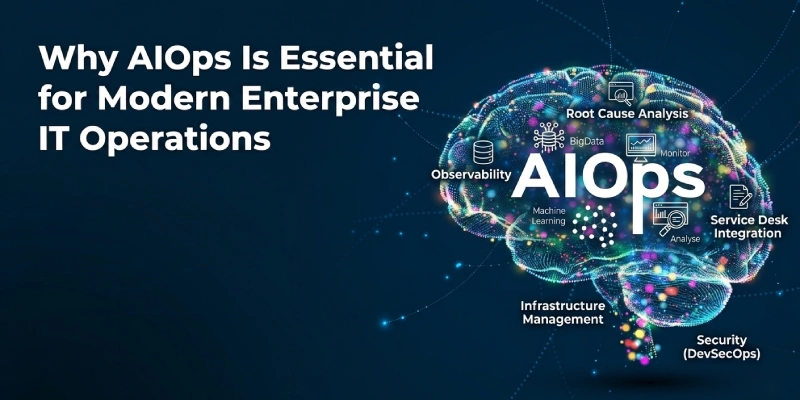
Why AIOps Is Essential for Modern Enterprise IT Operations
Discover how AIOps transforms enterprise IT operations with AI-driven automation, faster incident response, and predictive intelligence.
Introduction: The Complexity Problem in Modern IT
Modern enterprise IT environments have evolved into sprawling, multi-cloud ecosystems generating millions of operational events every minute. Traditional monitoring tools and manual processes-built for simpler, on-premises architectures-are no longer capable of keeping pace. The result: alert fatigue, slow incident resolution, and costly downtime.
This is precisely where AIOps (Artificial Intelligence for IT Operations) becomes indispensable. By embedding machine learning, advanced analytics, and intelligent automation directly into IT workflows, AIOps enables organizations to move from reactive firefighting to proactive, insight-driven operations management.
What Is AIOps?
AIOps, a term first coined by Gartner in 2016, refers to the application of machine learning and big data analytics to automate and enhance IT operations processes-including event correlation, anomaly detection, incident management, and root cause analysis. It sits at the intersection of observability, automation, and intelligence.
1. The Core Pillars of AIOps
AIOps is not a single product-it is a capability framework built on three foundational pillars that collectively transform IT operations:
1.1 Big Data Ingestion and Normalization
Enterprise environments produce an overwhelming volume of telemetry: logs, metrics, traces, events, and tickets. AIOps platforms ingest data from heterogeneous sources-cloud providers, on-premises infrastructure, APM tools, ITSM platforms, and more-normalizing it into a unified analytical layer.
1.2 Machine Learning and Advanced Analytics
Once data is centralized and normalized, ML models identify patterns, detect anomalies, and surface correlations that no human analyst could process at scale. This includes unsupervised learning for novelty detection, supervised classification for incident triage, and time-series forecasting for capacity planning.
1.3 Intelligent Automation and Orchestration
AIOps closes the loop by triggering automated remediation actions, routing incidents to the right teams, and suppressing noise-dramatically reducing manual toil and accelerating resolution workflows.
Traditional IT Operations vs. AIOps-Enabled Operations
| Traditional IT Operations | AIOps-Enabled IT Operations |
|---|---|
| Reactive-alert on known symptoms | Proactive-detects anomalies before impact |
| Manual correlation across siloed tools | Automated event correlation across all sources |
| High alert volume, frequent false positives | Noise reduction via ML-based filtering |
| Long MTTR-hours to days | Reduced MTTR-minutes to hours |
| Static thresholds and rules | Dynamic, self-tuning baselines |
| Siloed team handoffs | Cross-domain visibility and unified workflows |
Table 1: Traditional IT Operations vs. AIOps-Enabled Operations
2. Why AIOps Is No Longer Optional for Enterprises
2.1 The Explosion of Operational Data
According to IDC, the global datasphere will reach 175 zettabytes by 2025-a significant proportion of which originates from IT infrastructure. Kubernetes clusters, microservices architectures, serverless functions, and multi-cloud deployments all generate continuous, high-frequency telemetry. Without AI-powered aggregation and analysis, this data overwhelms operations teams instead of informing them.
2.2 Alert Fatigue Is a Business Risk
A 2024 survey by PagerDuty found that 70% of IT operations professionals experience alert fatigue, leading to missed critical incidents and burnout among on-call engineers. AIOps directly combats this by correlating thousands of raw events into a single, actionable incident notification-reducing noise by up to 90% in mature implementations.
2.3 Hybrid and Multi-Cloud Complexity
Most enterprises today operate across multiple cloud providers (AWS, Azure, GCP) alongside legacy on-premises infrastructure. Maintaining visibility and coherent operations management across this hybrid landscape requires an intelligence layer that can reason across domains-exactly what AIOps platforms are engineered to provide.
Key Insight: AIOps and FinOps Synergy
AIOps platforms can integrate with FinOps tooling to flag anomalous cloud spend patterns in real time-turning IT operations intelligence into a cost optimization driver. Organizations using AIOps for cloud cost anomaly detection report 15-25% reduction in unexpected cloud spend.
3. Core Use Cases Driving AIOps Adoption
3.1 Predictive Incident Management
Rather than waiting for an outage to trigger an alert, AIOps platforms analyze historical incident data and real-time telemetry to predict service degradation before it affects end users. This predictive posture enables pre-emptive scaling, configuration rollback, or human escalation-all before a P1 incident materializes.
3.2 Intelligent Root Cause Analysis (RCA)
RCA in complex distributed systems is notoriously difficult. AIOps uses topological mapping and causal inference to trace an observable symptom back through service dependencies to the originating failure point-dramatically reducing the investigation time that traditionally consumes senior engineers for hours.
3.3 IT Service Management (ITSM) Augmentation
AIOps integrates with ITSM platforms such as ServiceNow and Jira Service Management to auto-classify, prioritize, and route tickets. Natural language processing (NLP) enables intelligent ticket summarization and knowledge base suggestion, accelerating Tier 1 and Tier 2 resolution rates.
3.4 Capacity Planning and Performance Forecasting
Using time-series forecasting models, AIOps platforms project future infrastructure demand based on historical usage patterns, seasonal trends, and business event schedules. This empowers capacity planning teams to right-size resources proactively rather than reactively over-provisioning.
3.5 Security Operations Enrichment
AIOps enriches Security Operations Center (SOC) workflows by correlating IT operational signals with security telemetry. Abnormal network patterns that might indicate a breach can be surfaced alongside performance data, enabling faster triage and a more complete threat picture for security analysts.
4. Selecting the Right AIOps Platform
Not all AIOps solutions are created equal. When evaluating platforms, enterprise IT leaders should assess the following dimensions:
-
Data Integration Breadth: The platform must support native connectors to your existing monitoring stack-whether that includes Datadog, Dynatrace, Splunk, Prometheus, or proprietary tools. Vendor lock-in at the data layer undermines long-term flexibility.
-
ML Transparency and Explainability: Black-box models erode operator trust. Leading platforms expose model confidence scores, contributing signal weights, and explainable anomaly rationale-enabling engineers to validate and fine-tune AI recommendations.
-
Scalability and Latency: Enterprise-grade AIOps must process millions of events per second with sub-second correlation latency. Evaluate the platform's architecture (streaming vs. batch) against your operational SLA requirements.
-
Human-in-the-Loop Controls: Effective AIOps augments human expertise rather than replacing it. Platforms should support configurable automation guardrails-ensuring critical actions require human approval while routine remediations execute automatically.
-
Integration with DevOps Toolchains: AIOps generates maximum value when integrated across the full DevOps lifecycle-from CI/CD pipelines and change management to incident retrospectives and knowledge management.
5. Implementation Roadmap: Getting Started with AIOps
Successful AIOps adoption is iterative, not monolithic. A phased approach reduces risk and delivers incremental value:
1. Phase 1 - Observability Foundation
Consolidate telemetry data into a unified pipeline. Implement structured logging, distributed tracing, and metrics collection across all critical services.
2. Phase 2 - Noise Reduction and Correlation
Deploy AIOps for alert deduplication, suppression, and event correlation. Target: reduce actionable alert volume by 50%+ within 60 days.
3. Phase 3 - Predictive Analytics
Enable anomaly detection and performance forecasting. Begin correlating change events with incident patterns to build operational institutional knowledge.
4. Phase 4 - Automated Remediation
Introduce runbook automation for high-confidence, low-risk remediation scenarios. Continuously expand automation scope based on operator trust and outcome validation.
6. Challenges and Considerations
While AIOps delivers significant operational benefits, enterprise adoption is not without challenges. IT leaders should anticipate and plan for the following:
-
Data Quality and Completeness: ML models are only as reliable as the data they consume. Inconsistent labeling, telemetry gaps, or poorly structured logs will degrade model accuracy. Invest in data quality engineering before scaling AI capabilities.
-
Cultural Change Management: Operations teams accustomed to manual processes may resist AI-driven workflows. Success requires clear communication of value, transparent model behavior, and graduated automation that builds trust over time.
-
Skills Gap: AIOps platforms require staff with competencies spanning data engineering, ML operations, and IT domain expertise. Organizations must invest in training or partner with managed service providers to bridge this gap.
-
Vendor Selection Risk: The AIOps market is evolving rapidly. Evaluate vendors against your long-term architecture strategy and avoid platforms that create deep proprietary dependencies without open integration standards.
Conclusion: AIOps as a Strategic Imperative
The question for enterprise IT leaders is no longer whether to adopt AIOps-it is how quickly and strategically to do so. As infrastructure complexity continues to compound and business demands for digital reliability intensify, AI-driven operations management transitions from a competitive differentiator to a fundamental operational requirement.
Organizations that invest in AIOps today are building the operational intelligence infrastructure that will define their resilience, efficiency, and agility in the years ahead. From predictive incident management to intelligent automation and cross-domain observability, AIOps represents the evolution of IT operations into a data-driven discipline-one where machines handle the scale and humans focus on strategy.