
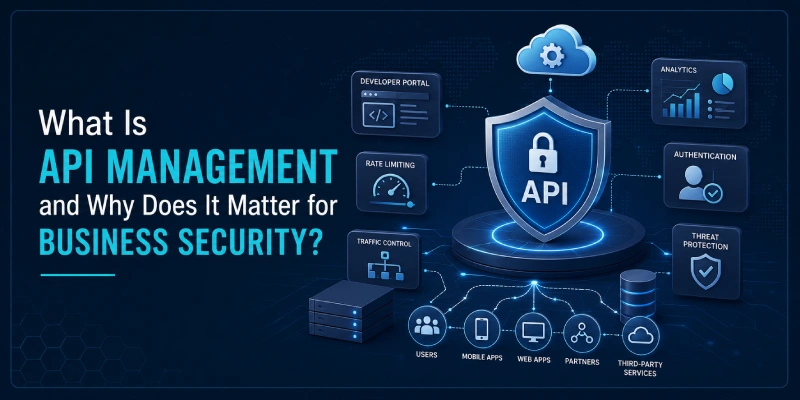
What Is API Management and Why Does It Matter for Business Security?
Every digital interaction your business powers - from a mobile banking transaction to a supply-chain update - now travels through an application programming interface (API). APIs have quietly become the connective tissue of modern software, and that makes them one of the most valuable - and most targeted - assets a company owns. API management is the discipline that keeps this connective tissue strong, visible, and secure. This guide breaks down what API management actually means, why unmanaged APIs quietly expose businesses to serious risk, and how a structured management strategy turns APIs from a liability into a competitive advantage.
API management is the practice of designing, securing, monitoring, and governing APIs across their entire lifecycle using a centralized gateway or platform.
It matters for business security because it closes visibility gaps, enforces authentication and access control, and prevents unmanaged endpoints from becoming attack entry points.
What Is API Management?
API management refers to the end-to-end process of creating, publishing, securing, monitoring, and controlling access to APIs throughout their lifecycle. Rather than treating an API as a one-time technical build, API management treats it as a living product - one that needs governance from the day it is designed until the day it is retired.
In practice, this involves a dedicated API management platform or gateway that sits between external or internal consumers and backend systems. This layer authenticates requests, enforces usage policies, logs activity, and shields core infrastructure from direct exposure.
API Management vs. API Gateway: What's the Difference?
The two terms are often used interchangeably, but they are not the same thing. An API gateway is a single component - the traffic-control point that routes, authenticates, and rate-limits requests. API management is the broader discipline that the gateway supports.
A single component acting as the traffic-control point. It routes requests, authenticates users, and applies rate limits. It is the "enforcer" at the entry door.
The broader discipline that includes the gateway, but also developer portals, analytics dashboards, versioning workflows, and governance policies. It defines the rules, tracks success, and evolves the strategy.
Put simply, the gateway enforces the rules at runtime; API management defines what those rules should be, tracks whether they are working, and evolves them as the business and its APIs grow.
Why APIs Have Become a Business-Critical Asset
Modern applications are rarely built as single, self-contained systems. They are assembled from dozens - sometimes hundreds - of internal and third-party APIs that move data between mobile apps, cloud services, partner platforms, and internal tools. This shift has made APIs a primary channel through which business value, and business risk, now flows.
As organizations adopt microservices, cloud-native architectures (such as AWS and Azure cloud solutions), and AI-driven applications, the number of exposed API endpoints grows rapidly - often faster than security teams can inventory them. This expanding, frequently under-tracked surface area is precisely what makes structured API management a security imperative rather than a purely technical convenience.
The Hidden Security Risks of Unmanaged APIs
When APIs are built and deployed without centralized oversight, they tend to accumulate risk silently. Security teams often discover these gaps only after an incident. The most common exposure points include:
| Risk Area | Business Impact |
|---|---|
| Shadow APIs | Untracked endpoints bypass security review, becoming easy entry points. |
| Broken Authentication | Attackers impersonate legitimate users to access sensitive data. |
| Excessive Data Exposure | Over-sharing in responses increases the impact of any single breach. |
| No Rate Limiting | Systems become vulnerable to abuse, scraping, and downtime. |
Industry research consistently flags these patterns as leading causes of API-related breaches. Organizations must address issues like SaaS sprawl and system design to mitigate these risks effectively.
A Practical Framework for Secure API Management
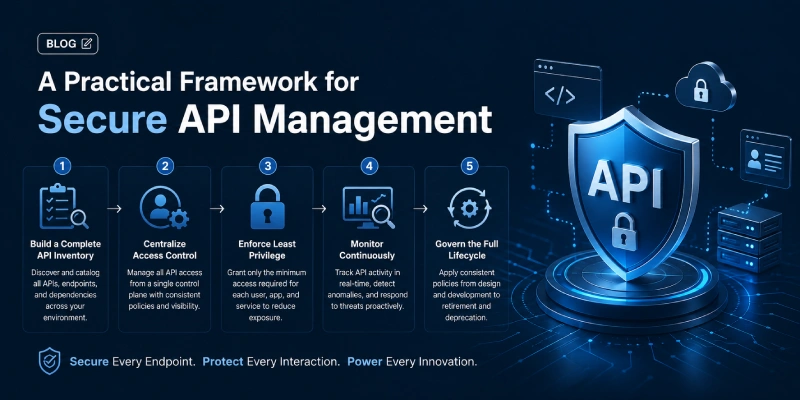
Solving API security is less about buying a single tool and more about establishing consistent practices across the entire API lifecycle. The following framework reflects how mature organizations approach it.
You cannot secure what you cannot see. Start by cataloguing every internal, external, and partner-facing API, including deprecated or legacy endpoints that may still be reachable. Automated discovery tools can help surface shadow APIs that manual audits often miss.
Route all API traffic through a managed gateway that enforces authentication (such as OAuth 2.0 or API keys), authorization scopes, and consistent security policies - rather than leaving each team to implement its own ad hoc controls. This is especially critical in cloud environments, where secure APIs and identity access management need to work together across every connected service.
Each API consumer, whether a partner application or an internal service, should have access only to the specific data and operations it needs - nothing more. This limits the blast radius of any single compromised credential.
Real-time monitoring and anomaly detection allow security teams to spot unusual traffic spikes, credential misuse, or data exfiltration attempts as they happen, rather than during a quarterly audit.
Version APIs deliberately, communicate deprecations clearly, and formally decommission endpoints that are no longer needed. Many breaches originate from APIs that teams assumed were already retired. Embedding security and compliance guardrails into the platform layer can help make these governance practices more consistent as APIs evolve.
How Strong API Management Strengthens Business Security
When API management is implemented well, its impact extends beyond IT. It reduces the likelihood of costly data breaches, supports compliance with regulations such as GDPR and industry-specific data protection standards, and builds the kind of reliability that partners and customers notice.
API management is not a one-time project - it is an ongoing discipline that pairs security controls with visibility across every API your business exposes. Organizations that treat API governance as a continuous practice detect and contain incidents faster, with less operational disruption.
How to Choose the Right API Management Solution
Organizations that map these criteria against their own risk profile tend to build API programs that scale securely instead of accumulating technical debt.
Frequently Asked Questions
A: Its main purpose is to control, secure, and monitor how APIs are accessed and used, ensuring reliable performance while protecting backend systems and data from unauthorized access.
A: API security is one component of API management. API management encompasses the full lifecycle - design, publishing, monitoring, and governance - while API security specifically focuses on protection from unauthorized access.
A: A shadow API is an endpoint that exists and is reachable in production but is undocumented, forgotten, or outside the visibility of the security team, making it a common entry point for attackers.
A: Yes. Any business exposing data or services through APIs benefits from basic governance, authentication, and monitoring, since attackers do not discriminate by company size.
A: Yes. Centralized logging, access controls, and audit trails make it significantly easier to demonstrate compliance with regulations such as GDPR, HIPAA, and PCI DSS during audits.