
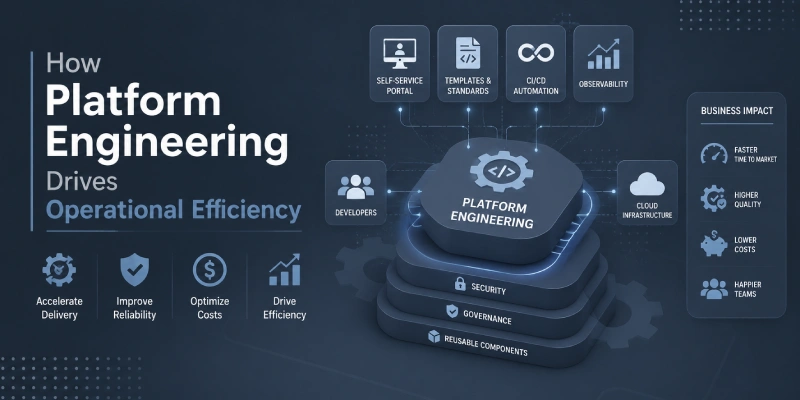
How Platform Engineering
Drives Operational Efficiency
Discover how platform engineering drives operational efficiency through automation, self-service infrastructure, and standardised workflows.
In today's fast-paced digital landscape, organisations face relentless pressure to deliver software faster, reduce downtime, and maintain consistent quality — all simultaneously. Yet many teams remain trapped by manual processes, fragmented tooling, and siloed workflows that quietly erode both speed and reliability.
This is precisely where platform engineering steps in. Far from being a buzzword, it is a disciplined, strategic approach to building and managing internal developer platforms (IDPs) that streamline the entire software delivery lifecycle — and one of the most powerful levers organisations can pull to achieve lasting operational efficiency.
This guide explores how platform engineering drives operational efficiency, why it matters for modern organisations, and how you can build the right foundation to unlock its full potential.
What is Platform Engineering?
Platform engineering is the practice of designing, building, and maintaining a self-service internal developer platform that acts as a foundation for all software development and operations activities. It abstracts the complexity of underlying infrastructure, toolchains, and policies — giving product teams a curated, reliable environment to build and ship software.
Unlike traditional DevOps — which blurs lines between development and operations responsibilities — platform engineering creates a dedicated platform team that treats the internal platform as a first-class product.
Core Components of an Internal Developer Platform
Infrastructure Automation
Automated provisioning, scaling, and teardown of cloud resources.
CI/CD Pipelines
Standardised, self-service pipelines for testing and deployment.
Observability Stack
Centralised logging, monitoring, and alerting to maintain system health.
Security & Compliance Guardrails
Built-in policies that enforce security without manual gatekeeping.
Developer Self-Service Portal
A unified interface for provisioning environments, deploying services, and accessing documentation.
The Operational Efficiency Problem
— and why it's getting worse
Operational inefficiency is not simply an inconvenience — it is a competitive liability. Teams lose hundreds of engineering hours each month to environment setup, incident response, manual deployments, and configuration drift. According to Gartner, by 2026 over 80% of software engineering organisations will establish platform engineering teams as the standard approach to scalable delivery.
Inconsistent environments causing 'works on my machine' failures in production.
Manual handoffs between development, security, and operations teams.
Lack of standardised tooling, leading to tribal knowledge and single points of failure.
Slow incident response due to fragmented observability and inaccessible runbooks.
Cognitive overload on developers managing both code and infrastructure complexity.
The DORA 2023 report found that elite-performing engineering teams deploy code 182 times more frequently than low performers, with a mean time to restore of less than one hour. Platform engineering is a primary enabler of these elite outcomes.
How Platform Engineering Drives Operational Efficiency
1. Standardisation Eliminates Toil
One of platform engineering's most immediate benefits is the elimination of toil — repetitive, manual, low-value work that consumes engineering capacity. By providing golden paths (pre-approved templates and workflows), platform teams remove the burden of reinventing solutions for common tasks. When a developer can spin up a production-ready environment in minutes rather than days, the compounding productivity gains are extraordinary.
2. Self-Service Reduces Bottlenecks
Traditional models require developers to raise tickets and wait for infrastructure, security, or operations teams to act. Platform engineering flips this model — developers can provision databases, configure pipelines, deploy services, and access credentials without waiting on a queue. This directly reduces mean time to deploy (MTTD) and accelerates time-to-market for every new feature or fix.
3. Improved Reliability Through Golden Paths
When teams use standardised, platform-approved tooling and configurations, defects caused by misconfiguration plummet. Platform engineering enforces consistency across environments, reducing environment drift and incidents caused by undocumented customisations.
Golden paths are not golden cages. Well-designed platforms provide standardised defaults while still allowing teams to deviate when there is a clear, justified business reason — balancing governance with genuine flexibility.
4. Faster Incident Response and Recovery
A mature IDP integrates observability tools, runbooks, and incident workflows so that on-call engineers can detect, diagnose, and resolve incidents significantly faster. Centralised logging and distributed tracing embedded directly into the platform remove the guesswork from troubleshooting — cutting mean time to resolution (MTTR) dramatically.
5. Security and Compliance by Default
Platform engineering bakes security and compliance controls directly into the platform layer, ensuring that every service deployed through the IDP adheres to organisational and regulatory standards — without requiring developers to become security experts. This shift-left approach reduces costly vulnerabilities reaching production and minimises time spent on compliance audits.
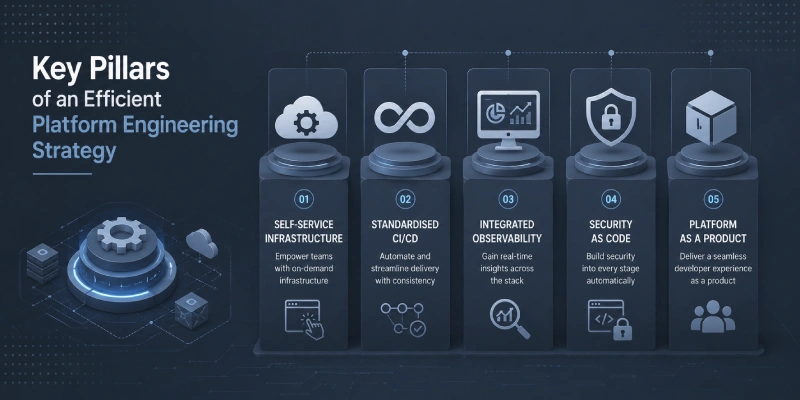
Key Pillars of an Efficient Platform Engineering Strategy
The five foundational pillars that drive measurable operational improvements.
Self-service Infrastructure
Standardised CI/CD
Integrated Observability
Security as Code
Platform as a Product
A Practical Implementation Framework
Implementing platform engineering does not happen overnight. A phased approach ensures adoption, sustainability, and measurable return on investment.
Assess & Define
Audit existing tooling and workflows. Identify the top five sources of toil. Define what operational efficiency means for your specific organisational context and map current pain points to platform capabilities.
Build the Core
Establish a dedicated platform team with clear ownership. Start thin: a working CI/CD pipeline, basic observability, and self-service environment provisioning. Adopt Infrastructure as Code — Terraform, Pulumi, or Crossplane.
Enable & Iterate
Publish internal documentation via a developer portal (e.g., Backstage.io). Collect DORA metrics and DevEx scores. Iterate rapidly based on team feedback; treat the platform like a living product with a roadmap.
Mature & Scale
Expand security-as-code policies and automated compliance reporting. Introduce advanced capabilities: feature flagging, chaos engineering, and canary deployments. Build a community of practice to drive organic adoption.
Measuring Operational Efficiency: KPIs That Matter
You cannot improve what you do not measure. Platform engineering teams should track the four core DORA metrics alongside platform-specific KPIs to build a comprehensive picture of ROI.
| KPI Metric | What It Measures | Elite Benchmark |
|---|---|---|
| Deployment Frequency | How often code ships to production | On-demand |
| Lead Time for Changes | Commit-to-production elapsed time | Days to Hours |
| Change Failure Rate | % of deploys causing incidents | < 5% target |
| Mean Time to Restore | Recovery time after an incident | < 1 hour (elite) |
| Developer Satisfaction | Pulse survey on platform quality | Monthly NPS |
| Toil Reduction Rate | QoQ drop in manual ops tasks | 20%+ per quarter |
Frequently Asked Questions
DevOps is a cultural and philosophical approach to bridging development and operations. Platform engineering is a specialisation within that philosophy — it focuses on building and maintaining the internal platforms, tools, and self-service workflows that make DevOps practices scalable and sustainable across large engineering organisations.
Platform engineering improves operational efficiency by eliminating toil through automation, enabling self-service workflows that reduce bottlenecks, standardising tooling to prevent misconfiguration, and integrating observability and security directly into the development lifecycle. These gains compound across the organisation to deliver significantly faster, more reliable software delivery.
No. While large enterprises have the most pressing need, the principles of platform engineering are equally valuable for mid-size organisations experiencing scaling pain. Many open-source tools — Backstage.io, Crossplane, ArgoCD — make platform engineering accessible even without large budgets.
Common tools include Kubernetes for container orchestration, Terraform or Pulumi for infrastructure as code, Backstage.io for developer portals, GitHub Actions or GitLab CI for pipeline automation, Prometheus and Grafana for observability, and Open Policy Agent (OPA) for policy as code.
Teams typically see initial productivity gains within 3 to 6 months of establishing foundational platform capabilities. Broader operational efficiency improvements — including measurable MTTR reduction and compliance automation — generally mature over 12 to 18 months as the platform evolves.
The four DORA metrics are the gold standard. Supplement these with platform-specific KPIs: self-service adoption rate, developer satisfaction scores (NPS), toil reduction rate quarter over quarter, and platform incident count. Together these provide a comprehensive view of platform engineering ROI.