
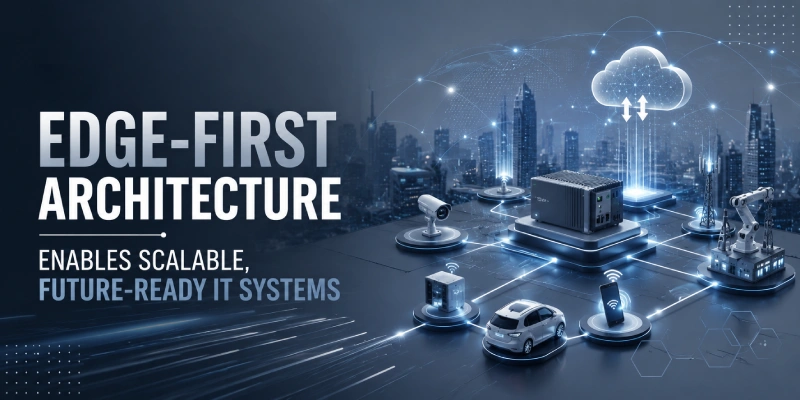
How Edge-First Architecture Enables Scalable, Future-Ready IT Systems
Learn how edge-first architecture helps IT teams build scalable, low-latency, future-ready systems. Practical guide with strategies, FAQs & more.
Introduction
Every millisecond matters in modern IT. Whether your organisation is streaming real-time analytics, managing autonomous devices, or delivering personalised digital experiences at scale, the gap between data generation and data processing has become a critical business liability.
Traditional cloud-centric architectures - where all workloads funnel into a centralised data centre - are struggling to keep pace. Latency spikes, ballooning bandwidth costs, and single points of failure are exposing the structural limits of legacy design.
Enter edge-first architecture: a paradigm shift that moves compute, storage, and intelligence closer to where data is actually created - at the network edge.
This guide breaks down what edge-first architecture means, why it is central to IT scalability, and how to adopt it in a phased, practical way - whether you are an early-career IT professional or a seasoned infrastructure engineer rethinking your modernisation roadmap.
The Problem: Why Centralised Architecture Has Hit Its Ceiling
Modern applications generate staggering volumes of data - from IoT sensors and connected vehicles to mobile apps and smart city infrastructure. Routing all of that data back to a central cloud creates compounding, costly challenges that no amount of additional cloud capacity can fully resolve.

Gartner forecasts that by 2025, 75% of enterprise-generated data will be created and processed outside traditional data centres - up from just 10% in 2018. This is not a gradual shift. It is a structural transformation demanding a rethink of every IT architecture decision.
What Is Edge-First Architecture?
Edge-first architecture is an IT design philosophy that prioritises processing data at or near its point of origin - at the 'edge' of the network - before selectively transmitting aggregated or filtered insights to centralised systems. It is not simply about adding edge nodes to an existing cloud setup. It means designing your entire infrastructure with edge capabilities as the primary compute strategy, not an afterthought.
Core Components at a Glance
Edge-First vs. Cloud-Centric: Head-to-Head Comparison
| Aspect | Edge-First | Cloud-Centric |
|---|---|---|
| Processing | At or near data source | In centralised data centres |
| Latency | Sub-ms to low-latency | Higher WAN latency |
| Resilience | Operates during outages | Single point of failure |
| Bandwidth | Local filtering, lower cost | Raw transfer, high egress |
| Scaling | Horizontal via distributed nodes | Vertical or cloud provisioning |
| Workloads | Real-time, latency-critical | Batch processing, archival |
| Data Residency | Native support | Requires configuration |
| Management | Edge orchestration tooling | Simpler cloud console |
Why Edge-First Architecture Enables True Scalability
Scalability is frequently misunderstood as simply adding more capacity. True scalability means handling growth in users, data volume, and operational complexity without proportional increases in cost, latency, or fragility. Edge-first architecture delivers this through three foundational mechanisms:
Horizontal Distribution of Compute
Rather than scaling a single powerful cluster vertically, edge-first systems scale by deploying additional edge nodes - each handling a discrete slice of workload independently. This horizontal model is inherently more resilient, geographically flexible, and cost-efficient. Failure in one node does not cascade to others.
Intelligent Data Reduction
Edge nodes pre-process data locally - filtering noise, aggregating telemetry, and running inference models - before transmitting only relevant signals to the cloud. This dramatically reduces the data volume traversing the network, cutting costs and improving end-to-end system performance.
Autonomous Operation
Edge nodes continue operating during cloud connectivity interruptions, making local decisions without waiting for centralised approval. This is critical in healthcare, manufacturing, and transportation - sectors where even brief outages carry severe operational or safety consequences.
Real-World Use Cases Across Key Industries
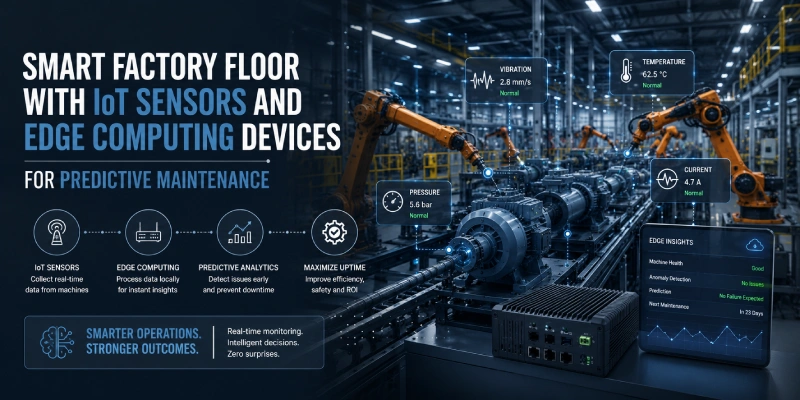
Real-Time Predictive Maintenance at the Factory Floor
Edge nodes embedded in production lines process sensor telemetry in real time, identifying equipment anomalies and triggering maintenance alerts before failures occur. This eliminates the latency of cloud round trips that could delay critical responses by critical seconds in high-speed production environments.
Resilient, Personalised In-Store Experiences
In-store edge systems power real-time inventory tracking, personalised product recommendations, and point-of-sale operations - even when internet connectivity is degraded or unavailable. Retailers using edge-first models report measurable improvements in transaction reliability and customer satisfaction scores.
Instant Clinical Alerts Without Network Dependency
Patient monitoring devices run inference models locally, analysing vitals and flagging abnormalities in real time - alerting clinical staff instantly without depending on hospital-wide network performance or cloud latency. In intensive care environments, this capability is not a convenience; it is a clinical necessity.
Split-Second Decisions at the Vehicle Level
Autonomous driving systems process LiDAR, radar, and camera data at the edge - onboard the vehicle - making navigational decisions in under 10 ms. Routing that decision-making to a cloud data centre would be physically and operationally impossible at the speeds involved.
5 Phase Implementation Framework for IT Teams
Transitioning to an edge-first model does not require a complete infrastructure replacement. A phased, evidence-driven approach lets IT teams validate ROI at each stage, build internal expertise, and minimise disruption to live systems.
Audit and Identify Edge Candidates
Map all existing workloads. Identify latency-sensitive, data-heavy, or resilience-critical operations where centralised cloud dependency is creating measurable friction, cost, or risk. Prioritise two to three high-impact use cases for initial deployment.
Select and Deploy Edge Infrastructure
Choose appropriate hardware - ruggedised edge servers or compact gateway appliances - and evaluate lightweight container orchestration stacks such as K3s or MicroK8s. Align selection with your workload requirements, environmental constraints, and budget.
Establish Central Edge Orchestration
Implement a multi-site edge management platform (Red Hat ACM, Azure Arc, or Google Anthos) to provision, monitor, and update edge nodes remotely at scale. This platform becomes the operational control plane bridging edge and cloud.
Integrate Zero-Trust Security and Observability
Apply zero-trust principles across all edge nodes: mutual TLS, least-privilege access, device attestation, and encrypted data transmission. Extend your observability stack (Prometheus, Grafana, OpenTelemetry) to include full edge telemetry for unified visibility.
Iterate, Optimise, and Scale
With a stable foundation, expand edge coverage iteratively. Introduce AI inferencing models, experiment with federated learning for cross-site insight, and continuously refine data filtering rules to reduce bandwidth costs further.
Begin with a single, tightly scoped use case. Measure performance improvements, cost reductions, and operational impacts rigorously and honestly before scaling. Successful edge deployments are built on evidence, not enthusiasm.
Challenges to Anticipate and Plan For
Edge-first architecture introduces operational complexity that should be acknowledged and planned for - not minimised. Informed teams build better edge systems.
Management Overhead
Distributed nodes require robust remote management tooling, disciplined change control processes, and well-documented runbooks for edge-specific incident response.
Expanded Security Surface
More nodes mean more potential entry points. A zero-trust security posture is non-negotiable. Continuous device attestation and anomaly detection are baseline requirements.
Skill Gaps
Edge engineering demands expertise across distributed systems, container orchestration, hardware provisioning, and network architecture. Plan upskilling investment early.
Vendor Fragmentation
The edge ecosystem is still maturing rapidly. Evaluate vendor lock-in risk carefully and favour open standards - CNCF projects, OCI containers, OpenTelemetry - wherever possible.
Frequently Asked Questions
QWhat is the difference between edge computing and edge-first architecture?
QIs edge-first architecture suitable for small or mid-sized IT teams?
QHow does edge-first architecture affect cloud spending?
QWhat security frameworks are best suited to edge environments?
QCan edge-first architecture coexist with existing cloud investments?
QWhat are the best orchestration tools for edge environments?
Ready to Future-Proof Your IT Infrastructure?
Edge-first architecture is not a distant aspiration - it is a strategic decision available to IT teams today. Whether you are evaluating distributed computing for the first time or actively planning an infrastructure modernisation roadmap, the right guidance accelerates your journey and eliminates costly missteps.
Explore Solutions